Wednesday, October 6, 2010

Godiva - Nerys Jones


Note: Hey all, I am back after a long while, this time for good.Mom has been sick, I have been sick and I have had a hectic few months of it but now I am resolved to continue blogging here regularly. Wish me luck!

I love all Godiva chocolates. Especially their chocolate covered pretzels. And the figure of the lady atop her horse that is their logo has always intrigued me. Who was Godiva? Did she really ride naked and bareback on a horse in Coventry in Anglo-Saxon England? If that is the case, what is the reason? Wikipedia gives you the answers, as I am sure, do numerous other websites or books if one was to search for them. But from what little I have read, I decidedly prefer Nerys Jones's Godiva.

England, AD 1045. Edward the Confessor, the childless, half-Norman, Virgin King is holding England by the sinew of her neck. He is the puppet master. The Normans are closing in and the three powerful Anglo-Saxon Earls of England: Siward of Northumbria, Godwin of Wessex and Lovric of Mercia have to do all they can to prevent their country from falling into the hands of the Normans; even if it means going to war against the king.

Into this hotbed is thrown Lady Godiva, the beautiful wife of the Earl of Mercia. King Edward has targeted the Lordship of Merica for reasons known only to him and Lovric and Godiva are fast falling from the favour of the court. Godiva's sons are captured under various false charges and leaving behind an earldom that is falling into famine and cattle plague, Lovric and Godiva must fly to Winchester to try and placate the king. In 1045 AD England, there are powerful manipulators abroad, the influence of the church is immense and the King continues to play games with his earls, his people and the future of his country. What does the king want with Godiva? Why have her family and her people been singled out? The machinations of the court go on forever and Godiva finds herself on shaky ground as her hitherto solid marriage is undermined, her children are in danger, her lands and her people in misery. The king is playing games and if she has to survive, if she has to win, so must she.

Nerys Jones's Godiva makes a wonderful read. Her style of writing is lucid and one cannot help but be fascinated at the threads of history that were woven a thousand years ago. I loved Nerys Jones's interpretation of the legendary horse ride and to me at least it seems more plausible than the explanation that Wikipedia has to offer. Godiva might not be a particularly great mother to her daughter Millie, she might be blind and heedless, she may not realize the true worth of her husband most of the time, but she is a fighter. She has pluck and courage and never gives up on her people as she tries to beat the king at his own game and for her, I can read this book again and again. Fans of historical novels will love this one.

Tuesday, September 7, 2010

The Girl with the Dragon Tattoo - Stieg Larsson


Well, I have finished it. This book that has been making headlines for quite some time now and this book that I have been resolutely keeping away from. I usually tend to hesitate reading books that have a lot of hype (I sort of feel bad for the writers when the books fall short as they sometimes do) surrounding them but this one was a gift from my cousin. He made it pretty clear: read it or else...

Mikael Blomkvist is an unlikely protagonist: he is a financial journalist and part owner of the Millenium magazine convicted for libel; he is a middle-aged divorcee who has a very fleeting relationship with his daughter and he is into a totally weird romantic entanglement with Erika Berger, his married colleague. Mikael Blomkvist does not elicit strong reactions of like or hate from the reader, the reader mostly feels neutral about him. He isn't a Rabbit Angstrom. On the other hand Lisbeth Salander, the second protagonist is all fire and ice. She is twenty four years old, distrustful, socially inept and declared incompetent by the local authorites and she is an expert hacker and security consultant.

Mikael Blomkvist is convicted for libel against a corrupt industrialist Hans-Erik Wennerstrom. His credibility as a journalist has plummeted and the magazine he co-owns with Erika Berger and Christer Malm has taken a huge hit. In the midst of this crisis he receives a call from Dirch Frode, lawyer of Henrik Vanger, former CEO of Vanger Corporation. Vanger offers Blomkvist a freelance job: to find out what happened to his grand niece Harriet Vanger who vanished forty years ago without a trace. Blomkvist leaves Stockholm and moves to the island of Hedeby for a year where he later joins forces with Lisbeth Salander. As the months progress, Blomkvist and Salander begin to unravel the mystery of Harriet Vanger's disappearance. There is a web of deceit, violence and perversity among the Vanger clan and nobody can be trusted. There is someone out there who will go to any lengths to stop Blomkvist and Salander from unravelling the mystery of what happened on Hedeby Island in the 1960s. Can they find out what happened to Harriet Vanger?

I loved reading the exploits of Blomkvist and Salander; the two are as different as chalk and cheese but together they make a terrific team. I am not a big fan of crime fiction but this one kept me up for the better part of last night. The Girl with the Dragon Tattoo makes for a riveting read but that is not all it offers the reader. The reader is taken into a world where things like family, security and normalcy are hard to come by. Each person in the book has a story; one more horrible than the other and makes you realize there exist in our soceity some very real ills that just cannot be ignored. In my opinion Lisbeth Salander was the hero, she was such fun to read about! You might not like her but you have got to admire her guts.

The Girl with the Dragon Tattoo is a complex psychological thriller ( I am not sure if this is everyone's cup of tea; some parts are decidedly technical) written in rich prose and I am sorry that Stieg Larsson is not around to witness its success. Thank you for the book Mr. Larsson.

Wednesday, August 25, 2010

Charlie and the Chocolate Factory - Roald Dahl


Yesterday evening on the bus I fulfilled a long ago wish. Charlie and the Chocolate Factory was one of those books that I just missed out on reading while growing up. Amidst all the Enid Blytons and the Arabian Nights and Puffin's Children's Classics, this one remained a book "that I should definitely read at least this year." Probably for the first time in a while I wasn't grumpy or irritated when I stepped off the bus after a two hour journey through an absolutely smog filled city. No. I was in chocolate land. And I am guilty of buying a bar of twix on my way home. Or two.

There is nothing new that I can say about Roald Dahl's Charlie and the Chocolate Factory that hasn't already been said. Everyone knows that he is a master story spinner and that this book is his best loved, probably ahead even of Matilda or the Fantastic Mr.Fox. I do not claim to review his book here nor am I going to analyze the storyline. I am simply going to gape slack-jawed and open mouthed at the fact that something he wrote years and years ago for children has that power to keep an adult (or semi-adult as the case may be :-]) agog till the last line. I have never believed in grown-ups phoo-phooing children's stories on the grounds that they have outgrown them long ago. Because no matter how many Sidney Sheldons or Dan Browns you might read, how big a fan of literary fiction or the classics you might be, what's the point if you are not able to appreciate a little Velveteen Rabbit or Scheherazade or Charlie Bucket every now and then?

I loved everything; I loved Grandpa Joe and Grandma Joe ( I found Grandpa and Grandma Geroge a little wimpy); I adored the huge bedstead that all the four grandparents shared; poor tired Mrs.Bucket who tries to slip her share of the meal to Charlie and poor tired Mr.Bucket with his "Cripes!" And then there is Willy Wonka and the Oompa-Loompas and the chocolate river and the snozzberries and the rainbow drops and the wriggle toffees and a million other chocolates (all that I want to list but won't in fear of irritating my readers further). And most of all there is Charlie; Charlie wins you over completely even before the story begins. I blame it on Mr.Dhal. How can you not love Charlie with an introduction like this one?

There are five children in this book:
Augustus Gloop - A greedy boy
Veruca Salt - A girl who is spoiled by her parents
Violet Beauregarde - A girl who chews gum all day long
Michael Teavee - A boy who does nothing but watch television
and
Charlie Bucket - The Hero


See what I mean? You stand no chance. It's a simple world, Mr.Wonka's. In his world, the good get rewarded, the bad get punished, the Oompa-Loompas sing songs about it and everything turns out alright in the end. "They all just come out of the wash in the end; they always do." I used to love Blyton's Magic Faraway Tree stories and Hogsmeade and the Weasley Twins' goodies from Harry Potter but this book took the chocolate/sweet fantasy to a whole new level. Mr.Dahl has influenced and taught generations of children how to dream and to imagine and that is no simple thing. A word for Quentin Blake: his illustrations brought the book alive and I enjoyed the story twice as much because of them. I am going to save the epithets beecause Mr.Dahl has received them all. Instead, I am just going to say that yesterday he gave me a gift that I don't come by too often. He made me feel five years old again.

Remembrance of things Paris - (Edited by) Ruth Reichl


Remembrance of things Paris is a collection of essays from the past sixty years from Gourmet magazine. Let me just come right out and say that this is going to be one of those books on my bedside table; I will beam at it every night and every now and then, when it is raining and I need something besides my faded flannel quilt, I will open its pages and take a fanciful flight right into the Parisian rooftops. That's the sort of foolish reaction any such cosy patchwork quilt of a book that is part food shrine, part travel memoir should elicit and in recent times, this collection has been among the very best.

The book opens with an adorable piece from Irene Corbally Kuhn; the year was 1921 and the month was May. In her own words: "The world had passed through the long darkness of the 'war to end all wars' and was more than ready for the frenzied gaiety and brief brilliance of the roaring twenties." And at the end of the essay: "Paris is also today - and tomorrow. Despite the encroachments of the startlingly new as in the Centre Pompidou or the ring of towering skyscrapers that seem to be closing in on all that has made Paris a place of unique beauty, it remains after two thousand years, more immutable than any other capital city in the world. Perhaps this is because so many of us left our youth there. And gladly."

There are essays that describe so eloquently of Paris coming to life after the second world war and about a shopper who bit into a baguette and cried out in pleasure because it was made of pure white flour and not the "coarse dark one" Parisians were forced to stomach during the occupation. There are vivid essays of the old flower market, Marche aux Fluers and Les Halles; having never been to that iconic market place, nevertheless, I ached along with the rest of them when I read about it being torn down. There are several pieces by turns charming, by turns satirical, by turns so lovely that you are almost dizzy and by turns down right contrary like Chicken Demi-Deuil by George Bijur, Paris One Step at a Time by Joseph Wechsberg, A Night at Les Halles by Alaire Johnston, An Insincere Cassoulet by Michael Lewis and my favourite in the entire book, She did not look like an actress to me by Hilaire du Berrier to name just a few.

There are several delightful write-ups on Paris's famed restaurant and bistro scene and there is one touching piece called The Three Musketeers by Patrick Kuh. Being as it is about Paris and more importantly, from Gourmet Magazine, the focus is on food but there several other eclectic pieces that are so absolutely Paris. The recipes given in this book are a treasure trove and I can't wait to try out some of the chocolate recipes but like Michael Lewis, I am something of a hypocritical non-vegetarian and found the descriptions of Sheep's Trotters and Calf's Bladder and tripe and giblets a little um, yucky.

This is the sort a book that will delight readers who love to read up on faraway places (even one that may be as overrated as Paris) and the million and one things that make up their soul. Readers who love a generous shot of the quaint and the whimsical in their reading will adore this book. This is the sort of a book that makes for a great holiday gift; one that sits by your kitchen counter as you try out one of the dozens of delicious recipes in it; the sort of a book that can grace any coffee table with aplomb. Read it on a train or plane or keep it by your night lamp like me. Beneath its covers Paris is spread out in splendid panoramic view; it pulls you in, drenches you and leaves you longing for the Paris of years gone by.

In the one week that I took to finish this book, it didn't take me too long to realize that I was being throughly seduced one page at a time by Paris. Read it and enjoy. I did. It was such fun to unravel so much about a city I know and love.

If you think you might be interested do read a similar article on my other blog There'sh a Moshkeeto in my Foog :)

Monday, August 23, 2010

The Einstein Girl - Philip Sington


Note: Hey all, I am back after a long absence. My mother has not been keeping well and she has just recovered. It feels great to write here again. I will visit all your blogs soon! :)

There is a line at the top of the book: "At the heart of truth lies madness.." and reading this book, you realize that it is so true. It is a web of deceit, intrigue, passion and utter loss of hope and as you delve into the book, it unravels before you and leaves you by turns aghast and spellbound at the turn of events.

The book opens in Berlin, May 1933: a woman named Alma haunts the local police station everyday in search of her missing fiance, Martin Kirch. And so Sington begins to tell us Martin Kirch's story and we are taken back to October 1932 when Martin's world changes irretrievably.

Psychiatrist Martin Kirch is a man who lives in the shadows of his past. He cannot get over the horrors of the great war where he had been an army doctor and contracts syphilis as a result. With Martin, engaged to be married into high society Berlin, one gets the sense that his life has been made but Sington lets you slip into the man's mind and you realize that they are still waters and that they run very deep. Martin Kirch is a man tormented with tertiary stage syphillis and the unenviable task of having to hide it from the public in fear of stigma. One thing remains for him to do: he must break his engagement. At this point, into Martin's life comes the case of a girl simply dubbed as The Einstein Girl. She is found half naked and near death in the woods outside the city and when she recovers from her coma, she can remember nothing. The only clue to her identity is a pamphlet found near her, advertising a lecture by Albert Einstein on Quantum Theory. Martin is struck by this girl and takes on the case and soon consumed with a reckless passion for the girl, he embarks on a quest for her identity that takes him Zurich, Serbia and a psychiatric hospital in Zurich to visit Einstein's son Eduard. Who is this girl and how is she connected with Albert Einstein? What will happen to Martin Kirch?

The Einstein Girl offers staggering foray into the mind and life of one of the greatest geniuses this world has seen. Sington has woven in the rise of the Nazi regime and the immediate effect it had on the medical world with amazing subtlety. In the hectic political climate of 1930s Berlin, power was everything and the Nazi's covert T-4 operation ( a euthanasia program odered in an effort to rid the German race of any "bad blood". Millions of special needs and psychiatric patients were put to death.) was already underway. You read the novel with a sense of foreboding and urgency because you, the reader, has some sense of the abyss into which Germany and the rest of Europe was about to be plunged. In the end, Sington leaves you with your heart breaking a little for Kirch, for the girl, for Alma, for Eduard and even for Einsten and you wonder at what might have been. Philip Sington's Einstein Girl may not be a book I might read a second time but I am glad I read it the first time around. The Einstein Girl's greatest strength might be the way it is written: fiction based on skeletal fact at its most chilling.

Wednesday, July 7, 2010

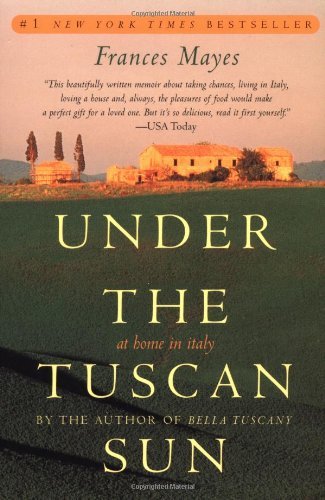
Under the Tuscan Sun - Frances Mayes

La bella Italia. I will never tire of reading about Italy. And reading this book, I need not close my eyes and concentrate hard enough for me to visualize anything. Italy is everywhere, on a vast canvas. On the stark white desk top at work, the cubicle walls, at home out on the porch, I have been seeing the Tuscan rooftops, the sun-mellowed walls and pretty faded blue and green shutters; olive groves and vineyards, a limonaia here, a bright bowl of clementines there; all parade in front of my eyes, they do not mock, they allure.

Under the Tuscan Sun is the journey of author Frances Mayes and her husband Ed in buying and restoring an old stone stone house, Bramasole (yearning for the sun), in the heart of Cortona, Tuscany. Bramasole, with a facade the colour of faded apricots and pretty green shutters enchants its way into your heart. Ms.Mayes comes to Bramasole at a crossroads in her life. In her own words, any arbitary turning along the way and she would be elsewhere; she would be different. Under the Tuscan Sun is not just the quintessential travelogue; unravel all the wonderous sights, people and food described till you can actually see all of it in front of you in glorious technicolour, and you will find a vein of seriousness, a rediscovering of the self, slowly, lovingly. This is what Bramasole nay, Italy itself becomes to her. Italy and Mayes come together not with flamboyance and pomp, but with a soft tread, a gradual understanding that deepens into an intense bond. The more she unravels the cultural layers of Italy, the deeper the bond becomes. This, I suppose is all that I am going to tell you about this book. The rest you will have to find out for yourself. Rest assured that it contains a magnificent account of life in rural Italy - the people, the place, Bramasole, the olive groves, the roses and the wildflowers, the vineyards and the food, always the food. These are the shades with which Mayes has painted her canvas but to me, what makes Under the Tuscan Sun such a winner is that it offers much more.

Read the book and revel in the delight that is Mayes's Italy. I can think of few better ways to spend my time. This is a particularly lovely section of the prologue that I just can't help copying:
"My reader, I hope, is like a friend who comes to visit, learns to mound flour on the thick marble counter and work in the egg, a friend who wakes to the four calls of the cuckoo in the linden and walks down the terrace paths singing to the grapes; who picks jars of plums, drives with me to hill towns of round towers and spilling geraniums, who wants to see olives the first day they are olives. A guest on holiday is intent on pleasure. Feel the breeze rushing around those hot marble statues? Like old peasants, we could sit by the fireplace, grilling slabs of bread and oil, pour a young chianti. Under the fig where two cats curl, we're cool. I've counted: the dove coos sixty times per minute. The Etruscan wall above the house dates from the eighth century B.C. We can talk. We have time."

I know that there are gazillions of travel books on Italy, books done, dusted and shelved but every once in a while you come across such gems as Living in a Foreign Language and Under the Tuscan Sun. What sets these books apart is their souls, which, I like to think is a direct extension of the writers'. In the case of Under the Tuscan sun, the soul is deep and reflective with flashes of humour here and there, but most of all, with an immense love for the land and the simple life. The kind of soul that rejoices in simple pleasures such as fireflies dancing in the night or chestnuts roasted by the fire. How can you not love that?


Saturday, July 3, 2010

In Xanadu - William Dalrymple


I didn't know much about Kubla Khan, except that he built this beautiful palace in Xanadu (from Samuel Taylor Coleridge's poem). I didn't care much either ways. Now I do. I care as much about the ruins of that "pleasure dome" in Xanadu as I do about the fact that Dalrymple could take that small vial of oil all the way there.

In a journey that takes him across holy land, hostile territory, prohibited high-security zones, William Dalrymple makes a fantastic, unbelievable journey to the remains of Kubla Khan's palace in Xanadu. He has a mission: to deposit in Xanadu, a vial of the oil he carries from the Holy Sepulchre in Jerasulem, thus fulfilling some semblance of the mission Marco Polo undertook in the eleventh century to spread Christianity in the court of Kubla Khan.

A book that tells of a heavy journey to be undertaken as this, a book that is a recording of the author's love for history, a book that has copious recordings of architectural details, multitude historical references that support the journey in reality from London, but for all intents and purposes from the Holy City to Xanadu: you don't expect it to be a light read. Amazingly, In Xanadu by William Dalrymple is ironic, light, witty and extremely funny on occasions.

This is Dalrymple's first book at the age of twenty-two and what a flowing debut! It begins somewhat ironically, with the Irish Franciscan complaining about the nuisance of maintaining the holy lamps that are supposed to burn eternally:
"I thought these lamps were miraculous. They are supposed to be eternal flames."
"That's what they say, but, you try changing the oil without getting them out. Damn it! This wick's finished. Pass me up the string."

"And who is this Italian you were looking for?"
Polo?"
"That's the one. He told you this oil was miraculous?"
"I suppose he did, indirectly."
"Well you can tell him from me it's quite ordinary."


And so he takes you, on this bewildering, magnificent, sometimes dangerous, sometimes downright scary, intense journey across Israel, Syria, Turkey, Iran, Afghanistan, Pakistan and finally, China. The route is hazardous: many nights are spent in coal trucks and filthy caravanserais. Dalrymple and his travel partners will spend much time getting disgruntled, trying to dodge officials, the maximum comfort they will face is a small seat on the floor with their rucksacks in the third-class compartment on a train to Peking. They will also meet people warm and friendly, people who help them along various stages of the journey, people who share what little they might have wholeheartedly with these strangers. They will drive across the Karakoram Highway in a truck full of chattering Afghans. They will brave the desert of Taklamakan in the back of a coal truck with a lone Uigur for company. They will meet dubious businessmen and vendors who try to fleece them. They will meet young Muslim men who are caught in the throes of confusion an in two minds about which world they really belong to. And they will have the time of their lives. It is true. They have a very smug "after" photo taken in the courtyard of Trinity College, Cambridge, to prove it.

In Xanadu is one of those rare historical travelogues that fulfill you without getting heavy. Just when you begin to think that the numerous historical recordings are getting monotonous, Dalrymple turns around and gives you a wry account of something very common place. And there, I think, lies the strength on this book. It doesn't bore. It educates but more than anything, it entertains. The balance is hard to find but William Dalrymple perfected it in his very first book. I loved the fact that Dalrymple doesn't fawn over the legendary Polo. His account of Polo is sometimes awed, sometimes exasperated but most of all, indulgent.

If you read In Xanadu, you would have done the unthinkable of being among the very first people to attempt a re-trace of Marco Polo's route to Xanadu, all from your armchair. It is a journey that you will not forget and at the very end, when you look upon the remains of Xanadu, you too will see the pleasure dome, the gardens, the splendor and the glory. You too will feel something profound when that soft earth at last absorbs the oil in that vial that became the ultimate reason for this journey. And you too will recite Coleridge's unforgettable Kubla Khan. And if you don't know it, you will definitely google it.